Carbon Dioxide
Enhanced Oil Recovery
http://www.netl.doe.gov/technologies/oil-gas/publications/EP/CO2_EOR_Primer.pdf
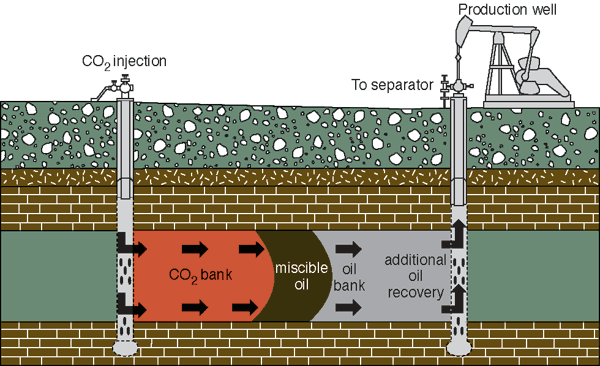
It is already used in several locations.
Posted on 12/26/2012 8:44:18 AM PST by T-Bird45
Winding from Coffeyville, Kan. to Burbank, Okla., is a pipeline project that maybe even Al Gore could love.
Chaparral Energy Inc. is building a line that will move carbon dioxide to help with enhanced oil recovery at the historic North Burbank field in Osage County. The project, due for completion early next year, initially will pipe about 23 million cubic feet of CO2 captured from a Coffeyville fertilizer plant.
"This is a very green operation," Chaparral CEO Mark Fischer said. "For the life of that (fertilizer) plant, the CO2 has been emitted into the atmosphere."
That, of course, is what Gore says is causing the planet to overheat.
But Chaparral will put the CO2 back into the ground as it uses the gas to recover oil from the mature fields that were once the province of industry legends such as a Marland Oil, Skelly and Phillips Petroleum Co. The 68-mile, 8-inch diameter pipeline will run from a compressor station at a fertilizer plant owned by a subsidiary of CVR Energy Inc. to the North Burbank site.
More at link
(Excerpt) Read more at tulsaworld.com ...
Ping — thought you might find this interesting. Hope your Christmas was great!
About six months ago I realized that this is the end game in putting aside objections to both carbon dioxide and energy exploration. Once a viable technique has been developed to frack using CO2 on a mass scale, then there can be no remaining arguments against turning the US into the world’s largest energy producer.
A few minutes of web research should explain the difference between putting CO2 into an oil-producing formation about 3000’ deep and a lake in Africa that has become carbonated due to volcanic activity. Your research should also show that scientists placed a method to resolve this problem in 2001.
I hope that most people understand that co2 are air sans oxygen
I grew up in Bartlesville and spent a lot time exploring Osage Hills State Park.
Why would you think that fracturing using CO2 is a good idea?
Liquid is used to carry the sand. The sand is necessary to hold open the cracks after the fracturing fluid is removed. The fracturing fluid must be removed to allow the oil/gas to flow back out the well head.
Your method, if it could even work, does not sequester the CO2. It would come back out before the production would start. Methods of CO2 flood as described in this article have been used successfully in Texas for many years. CO2 flood leaves the CO2 in the reservoir.
Carbon Dioxide
Enhanced Oil Recovery
http://www.netl.doe.gov/technologies/oil-gas/publications/EP/CO2_EOR_Primer.pdf
It is already used in several locations.

Air has very little CO2. It is mostly nitrogen.
Thanks for the link and the illustrations.
1. Liquid CO2 would carry sand just as easily as any other liquid.
2. CO2 can’t contaminate groundwater.
3. CO2 can be easily separated from the nat gas and reused.
4. Process would use far less water and produce far less liquid waste.
Did you ever jump into Sand Creek off the cliff?
I live in Osage country....and there’s quite a bit of drilling going on...of late.
Sorry, should have pinged you, too. I’m a former OS resident, graduated from Fairfax in 1973, mom passed in 2007 so I’ve not really spent any time there recently.
If you represented a volume of air with a 10,000 seat football stadium, CO2 molecules would be in only 3 seats.
No worries....you don’t know me. And how could you know I live in Osage Country?
Good Gawd...what will the tree’s breathe????
No, but I camped out on Sand Creek as a Boy Scout.
Disclaimer: Opinions posted on Free Republic are those of the individual posters and do not necessarily represent the opinion of Free Republic or its management. All materials posted herein are protected by copyright law and the exemption for fair use of copyrighted works.